 Finder Spreadsheet
The Chinese on a product page, field by field
Read the exact variant, quantity unit and measurements before ordering through Kakobuy. English interface buttons do not resolve Chinese seller specifications or confirm that a photograph matches your selection.
What the agent interface shows, and what it leaves alone
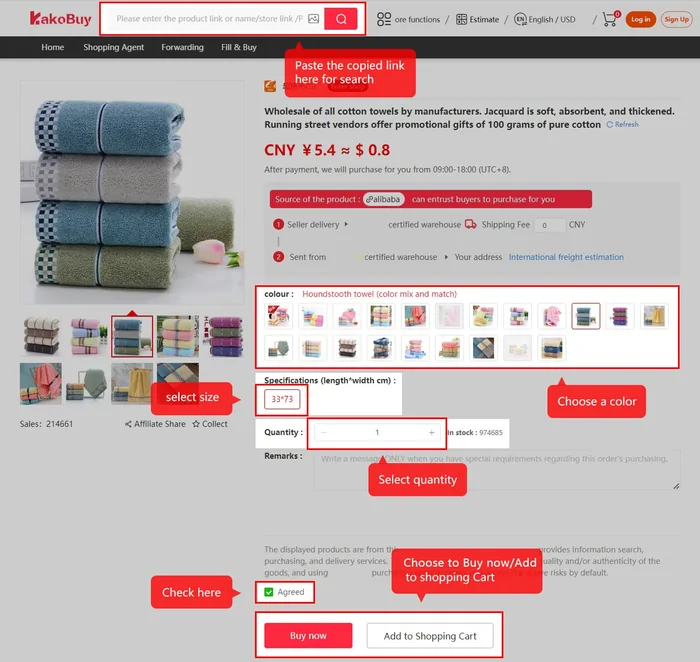
Open any find through the agent and the frame is English: Buy now, Add to Shopping Cart, a converted price (the tutorial’s towel reads CNY ¥5.4, about $0.8), and a working-hours note that purchases run 09:00 to 18:00 UTC+8.
Look closer at the parts that came from the seller. The colour row lists variant names the seller typed; the specification line shows a bare value (33*73, centimetres, for that towel); the stock counter read 974,685 and the sales counter 214,661 at capture. Those raw fields, not the chrome, decide what lands in your parcel.
The source platform matters too: that towel came from 1688, the wholesale marketplace, which brings its own ordering rules covered at the end of this page.
The same listing where the seller lives
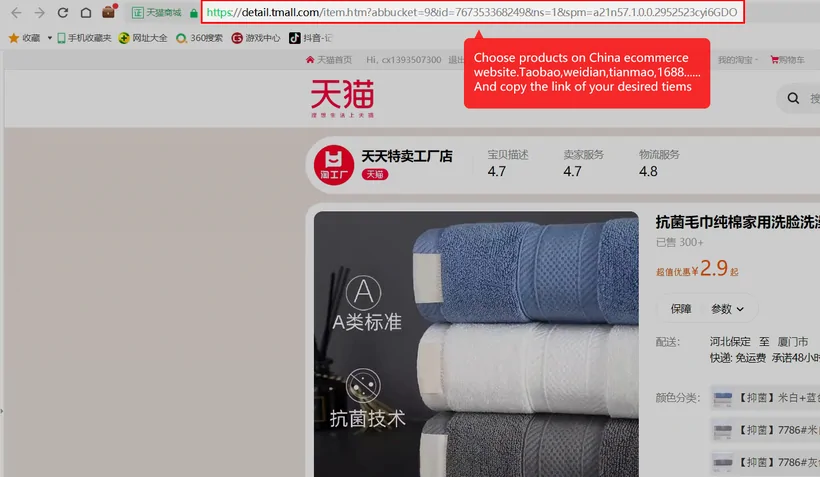
Click through to the source and this is the native habitat. Three counters orient you fast: 月销 (yuexiao, monthly sales) is monthly sales, 评价 (pingjia, reviews) is the review block, and 现货 (xianhuo, in stock) marks items shipping from stock. Sales and review counters use platform-specific rules. Read recent, relevant reviews and do not infer product quality from a large number alone.
Below the fold, Tmall-family pages carry a parameter table: fabric content, origin, article number. The article number, 货号 (huohao, article number), is quietly useful: searching it may reveal comparable listings, but repeated article numbers do not prove the same factory, material or version.
The variant picker: four tricks inside one field
The field labelled 颜色分类 (yanse fenlei, colour classification) deserves careful reading. The name promises colours; sellers treat it as a free-text menu for anything that changes the price. Four recurring patterns:
Literally: set / single piece
On a real order: Two rows, same photo: one sells the full outfit, one sells the top alone. The price gap is the tell.
If you misread it: Buyers pay the single-piece price expecting the set. The photo never promised anything; the row text did.
Literally: in stock / presale
On a real order: Appended to row names to mark which variants ship now and which wait for a production batch.
If you misread it: A presale variant may await a later batch. Ask for the promised dispatch date and what happens if it changes; the word alone does not establish an acceptable delay.
Literally: fleece-lined / regular
On a real order: Winter listings sell both weights under one photo set; the lined row costs a few yuan more and weighs more at freight time.
If you misread it: Order the lined version in July heat, or the thin one for a Berlin winter, and the mistake only shows on arrival.
Literally: giveaway / free extra
On a real order: Some rows bundle freebies: socks with shoes, a belt with trousers. The official help centre notes giveaways are not inspected and not guaranteed.
If you misread it: Do not rely on a giveaway when valuing the purchase. The captured inspection policy excludes giveaways; ask what was actually promised and what remedy, if any, applies.
The habit that defuses all four: read the text of your chosen row aloud, not the photo above it. The chosen row, listing description and seller confirmation should agree before payment.
The spec line: sizes, measurements, fill
Chinese sizing has three dialects on one page. Letter sizes vary by seller, brand and garment. Compare the listing’s measurements with an item you own rather than assuming a fixed size conversion. GB codes like 170/88A encode the body they fit: height 170 cm, chest 88 cm, regular build. And shoes list 适合脚长 (shihe jiaochang, fits foot length), fits foot length, in millimetres: measure your foot and use the seller’s stated sizing method; do not add a universal allowance.
A composition or fill percentage is a seller’s material claim, not a measurement of every feature that determines quality. For a coat, distinguish the fill percentage from the amount of filling. For denim, do not assume a 28码 label guarantees a measured 28-inch waist; compare the actual chart and measurement method.
When the spec line is a bare number pair like 33*73, check the stated unit and dimension order. In the illustrated towel listing, read the 33*73 specification with the seller’s description. The tutorial towel reads exactly that way.
How to choose a seller from the Chinese signals
Seller ratings and badges are context whose definitions depend on the platform. Read the badge’s own explanation and recent item-specific evidence before relying on it. A类标准 is a standards claim that needs the applicable product category and evidence; it is not by itself proof of independent testing.
Weigh three things in order: the exact specification, recent reviews about that item rather than delivery alone, and the seller’s stated return and dispatch terms. Treat ratings and counters as context, not guarantees.
Kakobuy’s captured 1688 rules advise checking seller credit and after-sales conditions. A score does not guarantee a return. Confirm the selected item, minimum quantity and seller response that applies to the actual request.
The 1688 special case: quantity changes everything
1688 is the wholesale floor of the same company that runs Taobao, and its listings price by volume. The unit price you see is a tier: 起批量 (qipiliang, minimum batch) rows on the page map quantity brackets to prices, and the official purchasing rules are blunt that unit price and shipping fee change with quantity, so your order must quote the exact figures.
Two official rules deserve memorising. First, every 1688 seller sets a minimum order quantity, 起订量 (qidingliang, minimum order quantity); an order below it is void and must be cancelled and re-placed. Second, for multi-piece cartons the agent counts boxes only and does not guarantee the piece count inside each box; quantity disputes get mediated with the seller, not refunded on the spot.
Practical translation: on 1688, read the quantity brackets before falling in love with the tier-three price, and expect the single-piece tier to cost visibly more than the headline. The fees page picks up what happens when a price shifts after payment.
Separate body size from garment size
A GB code may describe the intended wearer’s body dimensions, while a seller’s table may give the finished garment measured flat. Read labels such as 胸围 (chest circumference), 衣长 (garment length) and 平铺 (laid flat) before comparing numbers. Ask how the measurement was taken when the table is unclear.
Read one variant as four separate choices
黑色 加绒 单件 L describes black, fleece-lined, a single piece and size L. It does not say that the whole outfit in the gallery is included, that L matches your usual size, or that the item is ready to dispatch. Check each of those questions separately.
Save the chosen option text, seller URL and displayed price together. If the image says “set” but the option says 单件, ask what the selected price includes before paying. Then follow the actual order status; an accurate translation is not stock confirmation.