 Finder Spreadsheet
QC photos, the scale, and the shipping decision
Between storage and freight sit two moments that decide your satisfaction: visual inspection and weighing. Both leave fields on your order worth reading closely.
What QC covers, in the operator’s own scope
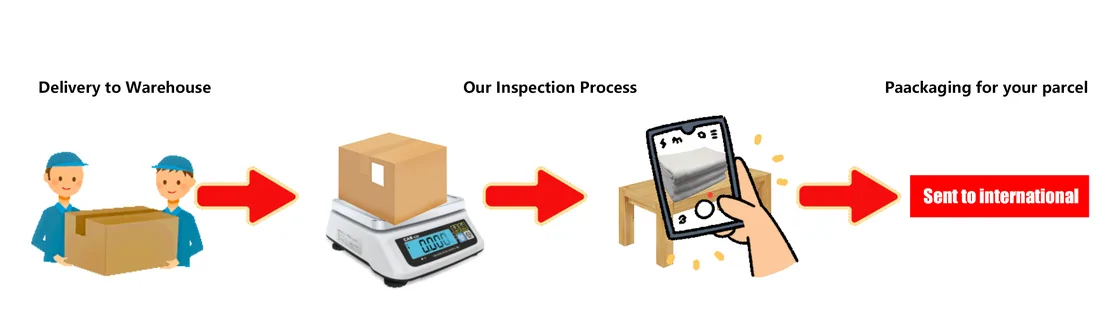
The official inspection rules draw a tight boundary: appearance only, checking model, style and size. Garments, bags, suitcases and shoes get opened; anything sealed or carrying security strips stays closed and gets an outside-only look. Electronics explicitly skip authenticity, function and quality checks.
Giveaways, the 赠品 (zengpin, free extras) rows from the variant picker, are excluded from inspection per the help centre, which is why this site keeps calling them ballast. And the free photo count is not published on the official site; the paid personalised photograph service exists for angles you must have.
How to check QC photos when they land
Work the photos against the listing, not your memory. Confirm the variant: the row text you ordered, 颜色分类 and all, should match what the tag and colour show. Then the size tag: GB codes photograph crisply, and a 170/88A tag on an order meant for 180/96A is a mismatch to raise promptly while an eligible return may still be possible.
Tags often photograph in Chinese: 洗涤说明 (xidi shuoming, care instructions) washing instructions, 成分 (chengfen, composition) the fabric content line, both matchable against the listing’s parameter table even without reading every character. Shape matching works: find the characters from the spec table in the photo.
The clock matters more than the magnification: the seller-side 5-day exchange window documented on the status page runs from stock-in, so photo review is a same-day task, not a someday one. Flag mismatches to support immediately with the photo and the listing row side by side.
The scale: actual, volumetric, and the one that bills
Every stored line carries measured weight in grams and volume in cubic centimetres. Some lines bill actual weight; others compare it with volumetric weight using a route-specific divisor; the official courier-fee articles explain the mechanism and the per-line estimator applies it per route.
Consolidation is where the mechanism pays you: combining suitable items may avoid repeated minimum charges, although larger dimensions or mixed restrictions can erase that benefit, and the official line on consolidation is that it is free in China, including the inspection. Vacuum packing, a paid option, attacks the volumetric side for puffy textiles like the down coats in the catalogue’s winter rows.
Reading the official freight quote like a local
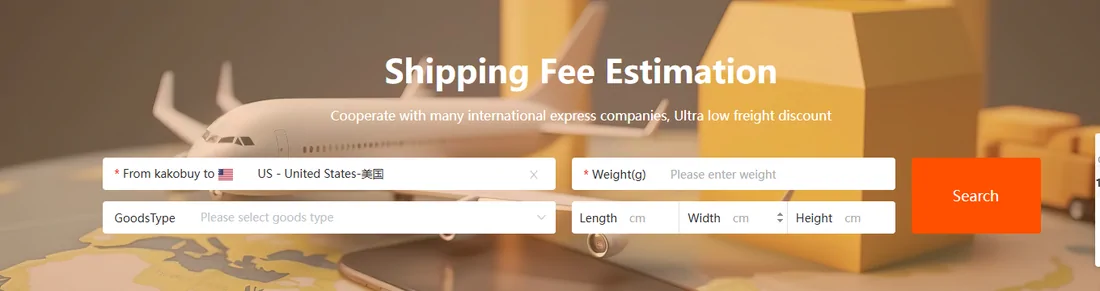
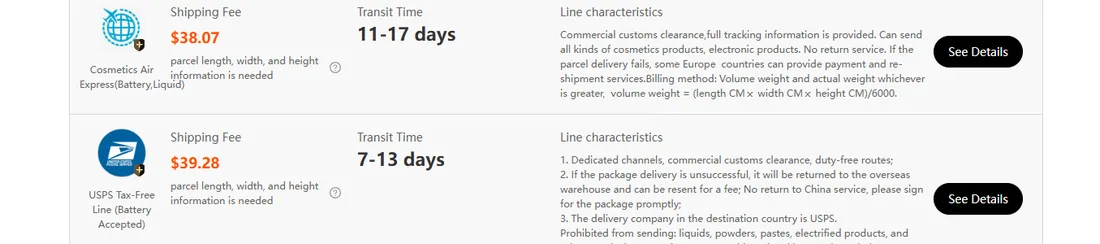
The retained 10 October 2026 US quote for a 1,000 g ordinary-goods example ranged from about $38 to $53 across listed lines. These are historical example values. Re-enter your destination, contents, packed weight and dimensions; a past range does not establish today’s spread or availability.
The columns to read after price: battery and liquid acceptance (the goods type field filters this), weight floors (two greyed lines that day required 2,000 grams minimum), and whether the line bills actual or volumetric weight. Line characteristics also note who clears customs; the fees page covers the declaration rules that follow from that.
Choosing a line without memorising the catalogue
Start with route acceptance of the exact contents, then check weight/dimension limits and the current duty wording. Battery and liquid labels are broad categories; they do not automatically accept every battery or perfume. A duty-inclusive route can still require recipient documents or exclude charges, so read the actual conditions.
After those three, also compare cover, claim conditions, tax handling, tracking and delivery-area exclusions. Transit ranges are estimates, not guarantees. The habit worth forming: quote the estimator before buying heavy items, not after; a $50 freight reality reshapes what a ¥200 find is worth.
Make the missing evidence specific
If the photo does not answer your question, name the OG item number and ask for the detail you need: the size label, a seam, included accessories or a measurement with both tape endpoints visible. Keep the listing and photo together when describing a mismatch to support.
Translate the label, then check what it proves
成分 identifies a composition field and 洗涤说明 identifies care instructions. A clear warehouse photo can help you compare the label with the seller’s claim, but it cannot chemically verify the material. Likewise, matching a size code confirms the photographed label, not the finished garment’s measurements.
If the question is a visible mismatch, send the selected option and relevant photo together. If it needs a test outside the published inspection scope, ask whether that service exists before assuming another photo will resolve it. Use the official order-support route for the actual case.